
Alexander County Parole and Probation
North Carolina uses several terms for supervision in the community. Probation is a court-ordered sentence or condition that can occur without a prison term, or after a short period of confinement. Parole is an early, conditional release mechanism that now applies mainly to older or special sentencing groups. Post-release supervision is the usual term for the community phase of many current state prison sentences. Under G.S. 15A-1368, a person on post-release supervision remains in the custody of Community Supervision and the North Carolina Post-Release Supervision and Parole Commission before the maximum term ends.
This distinction explains a result that can look inconsistent. The North Carolina Department of Adult Correction, or NCDAC, may show an Actual Release Date while the Probation/Parole/Post Release Status remains active. The date marks release from imprisonment. The active status marks a legal duty that continues in the community. Neither status should be treated as proof that a sentence has fully terminated.
| Supervision type | How it begins | Best verification | What release means |
|---|---|---|---|
| Probation | Court judgment or sentence condition | OPI status, court judgment, and listed office | The person may never have served a state prison term |
| Post-release supervision | Community phase before the maximum prison term ends | Actual Release Date plus active post-release status in OPI | Prison custody ended, but supervision did not |
| Parole | Commission action for an eligible sentence | OPI parole dates, status, and Commission record | A review or grant is not the physical release record |
| Pretrial supervision | Court conditions before a case is resolved | Court order and Alexander Pretrial Release office | It is not probation, parole, or sentence discharge |
- Discharge
- The formal end of a supervision term or sentence status, not merely departure from a jail or prison.
- Absconder
- A supervisee whom NCDAC identifies as actively avoiding supervision and whose whereabouts are unknown.
- Revocation
- A legal action that can return a person to custody after a violation finding.
- Detainer
- A request or hold from another authority that may affect custody or release.
Verify Alexander County Post-Release Status
The primary public lookup is NCDAC Offender Public Information, known as OPI. It covers North Carolina state prison history and Community Supervision, not a county-jail-only stay. Search by the seven-digit offender number when known. A name search can return several people, so compare the name, birth information, offender number, and other displayed identity details before relying on a result.
- Open OPI and search the offender number. If it is unknown, use surname, given name, status, and available identity filters.
- Open the matching individual record only after comparing the displayed identity fields. A same-name match is not enough.
- Read the top Inmate Status and Probation/Parole/Post Release Status before reviewing older sentence entries.
- Find the listed supervising office, parole dates, Actual Release Date, Service Status, and sentence status for the relevant case.
- Confirm the office through the current NCDAC Community Supervision directory before making an in-person visit.
- Use the court judgment when the question concerns the terms imposed by a judge. Use NCDAC for the current state supervision status.
A released Alexander County jail detainee does not appear in OPI solely because of a county booking. OPI becomes relevant if the person entered state prison or has state probation, parole, or post-release supervision. For a county release event, the Alexander County Detention Center release transaction remains the closer proof. The broader Alexander County released-inmate search and record path is available on the home page.
The official Community Supervision office directory is shown below as it appeared when captured. Its source should be checked again because district rosters and reporting instructions can change.
Open the current NCDAC office directory.
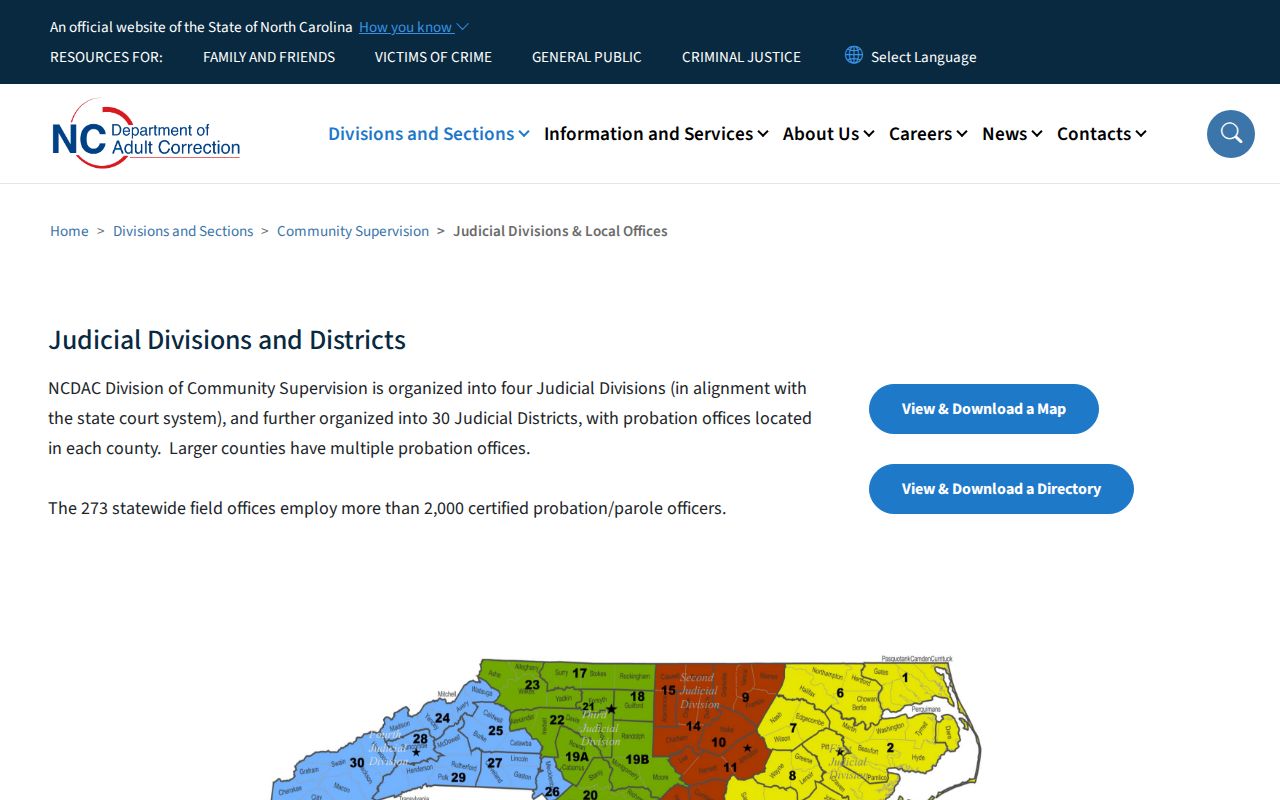
The directory is the correct place to verify a current office, while the individual OPI record identifies which office is tied to the person.
Alexander County Supervision Offices
The September 2025 field roster placed Alexander County in Judicial Division 3, District 22 with Davidson, Davie, and Iredell counties. District headquarters was listed at 507-C West Center Street in Lexington. The Alexander County telephone directory separately lists “Alexander Probation.” The local phone is useful for routing, but NCDAC should confirm the current street address and any reporting directions before travel.
District 22 Community Supervision Headquarters
507-C West Center Street
Lexington, NC 27292
336-249-9332
Alexander Probation listing
828-632-1125
Alexander County telephone directory
Office staff can help confirm routing and reporting information. They do not replace the court when a judgment or violation order is needed, and they do not replace the jail when the issue is the exact moment of release from the Alexander County Detention Center. Keep the offender number and relevant case number ready so the inquiry points to the right record.
Alexander County Absconder Status
An active supervision record does not, by itself, show whether all conditions are being met. Conditions come from the judgment, supervision law, and instructions for the case. They may address reporting, residence, treatment, movement, or other duties, but the public OPI summary is not the full supervision file. NCDAC protects parts of supervision records, so a missing detail should not be guessed.
NCDAC provides a separate OPI Absconder Search. The agency defines an absconder as someone actively avoiding supervision whose whereabouts are unknown. Search and identify the person with the same care used in the main OPI system. An absconder result supports the conclusion that supervision is unresolved. It does not, on its own, prove a current arrest warrant or show that the person is in the Alexander County Detention Center.
View the official NCDAC Absconder Search form.
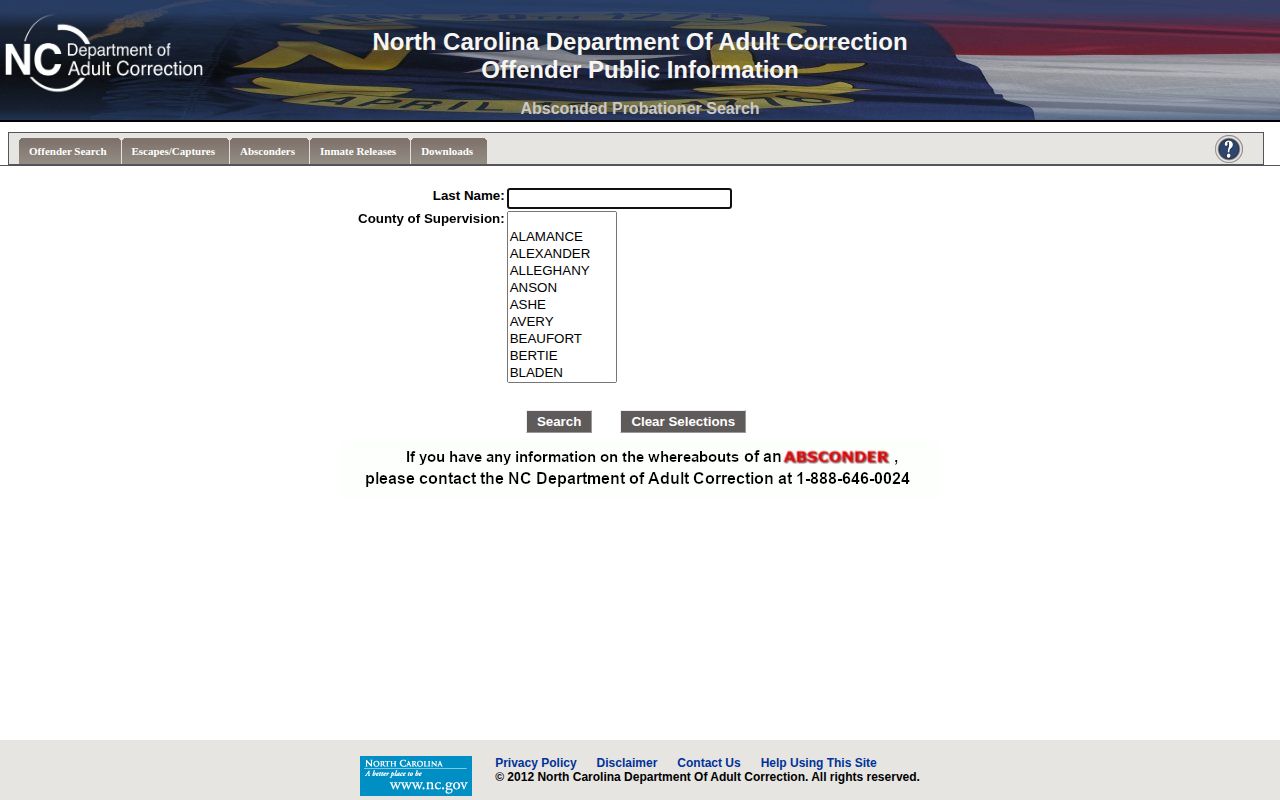
The separate form helps distinguish an absconder inquiry from a current jail-custody check. NCDAC also publishes an anonymous tip line at 888-646-0024.
Alexander County Parole Commission Records
The North Carolina Post-Release Supervision and Parole Commission oversees modern post-release functions and older discretionary parole cases. Structured Sentencing generally abolished parole for offenses committed on or after October 1, 1994. Older eligible cases and a limited set of later cases can still receive Commission review. That makes the offense date and sentencing regime essential before describing someone as parole eligible.
The Commission publishes monthly discretionary parole-review reports, not a future public calendar for each individual. Report terms such as incomplete, suspended, regular parole, community service parole, early medical release, and 90-day mandatory parole describe review outcomes. A grant or favorable review category still does not establish the prison exit time. Confirm the later Actual Release Date and top supervision status in OPI.
Victim meetings with a commissioner are a separate process and are not public offender hearings. The official Commission information describes weekly appointments requested by phone. Do not convert that meeting schedule into a parole hearing calendar.
Alexander County Release Support Paths
Alexander County operates local programs that can place a person in the community under conditions, but their roles must stay distinct from parole. The Pretrial Release and Resource Referral Services office supervises qualifying defendants awaiting trial under court-set terms and receives some sentenced probation referrals based on assessed needs. Its office is at 81 NC Highway 16 North, Suite F, Taylorsville, with phone 828-632-2114 and weekday hours from 8:00 a.m. to 5:00 p.m.
The county has operated Pretrial Release/RRS since 2003. A participant may be out of jail and subject to court conditions without being on parole. Likewise, a probation referral can lead to local services without proving when the person left custody. The court order, jail release transaction, and supervision record each answer a separate part of the question.
Alexander County also documents a jail-connected PORT community-paramedic program. PORT staff connect some jail clients with treatment and resources in coordination with detention and Pretrial Release personnel. Participation is not automatic, and a referral is not a release record. Still, it is a distinctive local route that may explain service contact after someone returns to the community.
Alexander County Supervision Discharge
Supervision ends through a formal status change, not simply because an office visit stops or a person leaves prison. For post-release supervision, G.S. 15A-1368.5 states that supervision begins on the day of release from imprisonment. OPI may later show an inactive or completed service status, but the relevant sentence and supervision entries must be read together. Probation ends under the court judgment and any later orders. Legacy parole follows its own Commission and sentence record.
Check the search date because OPI can update. Preserve the offender number, top status, office, Actual Release Date, and service status from the same view. If the status appears wrong, contact NCDAC with the exact disputed field and supporting record rather than assuming a county jail or court correction will flow automatically into OPI.
North Carolina SAVAN can provide custody-change notices, but an alert is not a discharge certificate. A release notice may arrive while probation, parole, or post-release supervision remains active. The durable answer comes from the supervision status, the applicable judgment or Commission record, and direct confirmation from the office assigned to the case.
Note: Release from confinement and discharge from Alexander County supervision are separate events and may appear on different records at different times.